Clews & Curios · Historical Background
Sex in the Dark Lantern Tales?
Where’s the racy stuff? — the short answer is that these stories were directed at what we’d now call a prime-time TV audience.
The simple answer is that these stories were directed at what we would now consider a prime-time TV audience. There is a fair amount of good ol’ American violence drama, but nobody gets laid, at least not overtly. Buried in the stories are more than a few references to adult behaviors, and Albert W. Aiken also wrote stories that include at least a couple of Lesbian characters and also characters that might now be called transgender. However, there is still not much that could be called erotic.
Some of the Beadle’s stories were first published in what were called story papers, and these were generally for the whole family. Story papers were weekly publications with overlapping serialized stories aimed at the varied interests of family members. A typical issue might contain a romantic story segment for Mother, a juvenile series for the youngsters, a bit of saccharin poetry, and a more robust story for Father and the older boys, also serialized. The goal was to engage the whole family and sell the papers by subscription.
A good read on the subject is the engaging book about the Everleigh Sisters in Chicago, Sin in the Second City, by Karen Abbott (Random House).
Victorian erotica did exist — elsewhere
Contrary to popular belief, erotic literature and images were not hard to find in the Victorian era. By the middle of the nineteenth century, American newspapers carried carefully worded advertisements which noted when favorite professional ladies had taken up residence in a new house. There were also city directories that mentioned where one might find companionship for the evening on a commercial basis, or where “Houses of Assignation” could be found for a discreet visit (the original “No-Tell Motel”). Prostitution was not deeply hidden in most US cities of the period, although relegated to certain areas of town for the most part.
Cameras had not been invented long before they were pointed at naked ladies, and the tiny Stanhope viewers could offer a bit of visual frisson in a watch chain charm. American soft-covered publications with erotic content are more difficult to locate, partly from the assertive censorship promoted by Postal Inspector Anthony Comstock, beginning in the early 1870s. Also, relatives who discovered some racy material while going through the effects of a recently passed Granddad probably just discreetly tossed it out.
If you search for British magazines like The Pearl and The Oyster, you can find plenty of erotic writing from the 1870s and 1880s. Between the literature and the photos, it is clear that not much new in the way of sexual activity has been tried, even in our more enlightened times.
Police Gazette and ribald wax cylinders
Richard K. Fox bought a tired old publication, The National Police Gazette, and turned it into the seminal scandal rag, sports digest, and sensational illustrated magazine of the age. Described with euphemisms, prostitutes are pictured in provocative situations, and plenty of show girls in scanty costumes decorate most issues.
Recently this writer heard about ribald audio recordings of the 1890s released on CD by Archeophone Records. These were transcribed onto wax cylinders one at a time. Commercial players, each play typically costing a nickel, let listeners hear through a rubber tube to each ear. Players like that were in many public places, but when placed in the back of a bar or pool hall, the player could be loaded with one of these “adult humor” recordings. Anthony Comstock’s minions raided saloons, made arrests, and confiscated recordings — but they didn’t find them all.
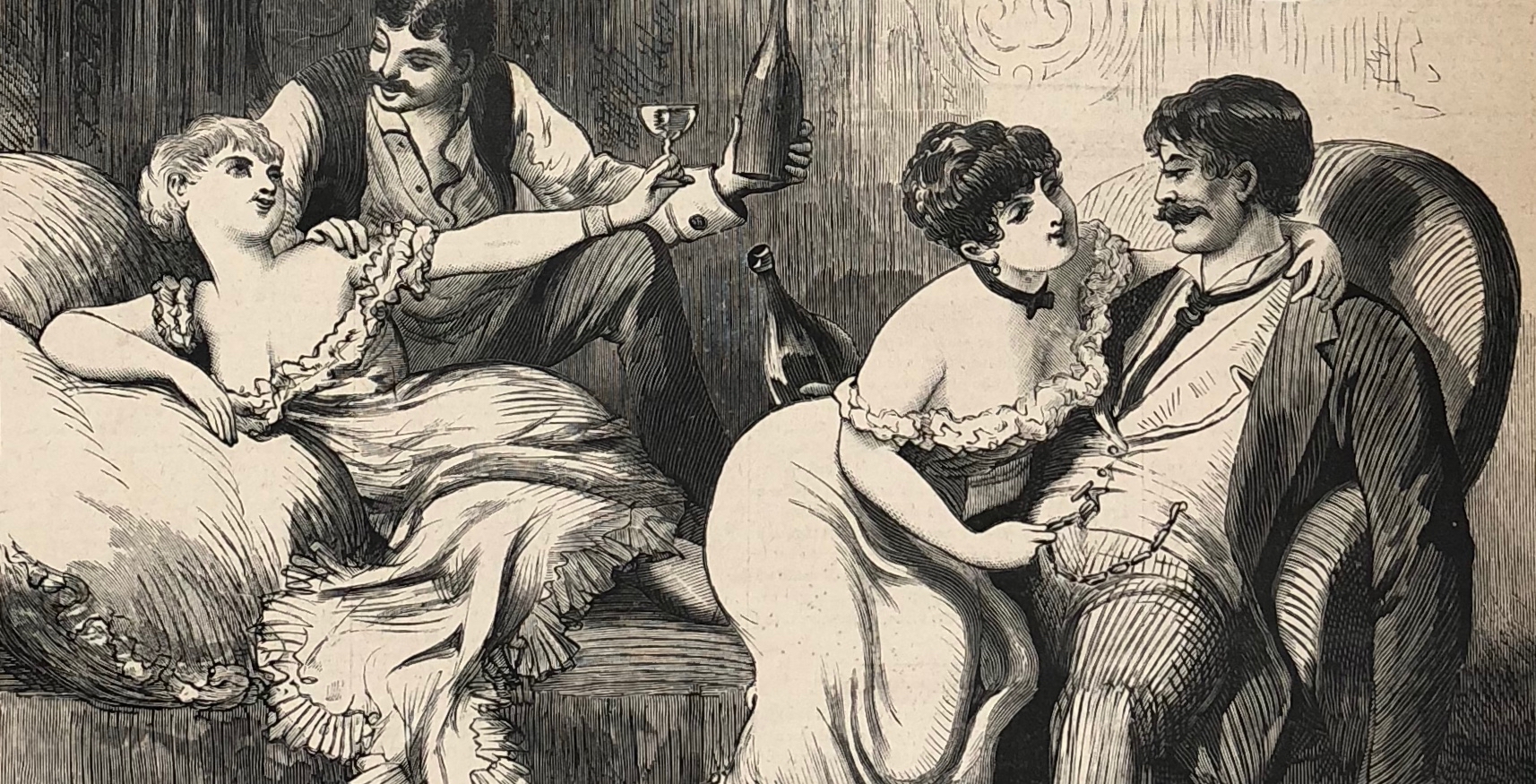
A period print — the Victorian era was racier underneath than its public-facing literature ever was.
I wish you good hunting if you choose to search for period erotic literature on the internet. The Dark Lantern Tales titles, however, will continue to be chosen from the popular literature for the broader, “prime-time” audience.
Listen at Archeophone Records
Actionable Offenses — Wax-Cylinder Recordings of 1890s Adult Humor →
“History is complex, and the private behaviors of modern people were similarly present in the past.”
— Mark Williams, Dark Lantern Tales