
Clews & Curios · NYC Stories
Recording Sound
1877 — Edison’s tin-foil phonograph changed the relationship between a voice and the passage of time, forever.
When Thomas Edison demonstrated the tin-foil phonograph in 1877, he changed the relationship between sound and time forever. For the first time in human history, a voice could speak and then be heard again — not from memory, not from written description, but as itself, preserved in the grooves of a turning cylinder.
The technology developed rapidly through the 1880s and 1890s. Alexander Graham Bell’s team improved Edison’s design with wax-coated cylinders, and by the final decade of the century, competing formats were vying for commercial dominance. Early recordings were quiet, low-fidelity, and painfully brief — but they captured something that had never existed before: the actual sounds of the nineteenth century, fixed in a medium that could carry them forward into the future.
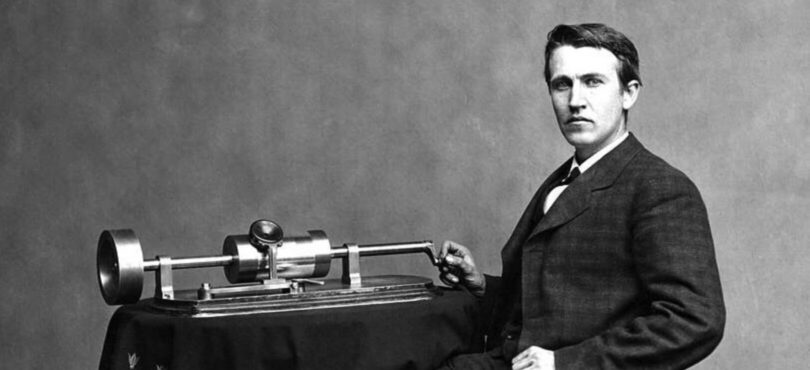
Edison’s tin-foil phonograph — the first machine to record and play back human speech.
The Dark Lantern Tales novels draw on extensive historical research, and Syracuse University has been a valuable resource — particularly in providing information on Street & Smith, the legendary New York publishing house that produced many of the original dime novels from which these stories have been rediscovered and republished. The world of late nineteenth-century publishing, invention, and popular culture all converge in the same remarkable era.
Read at Syracuse University
“Of all my inventions, I liked the phonograph best.”
— Thomas Edison