
Clews & Curios · NYC Stories
The History of an Alley
Stuyvesant Alley — a narrow East-Village passage between buildings that survived centuries of New York’s reinventions.
Dark Lantern Tales novels are generally from the 1870s to the 1890s, and some of them refer to undeveloped land to the north of New York City proper. In the years around the 1880s, the area between New York and Harlem was farmland evolving into development, shanty towns, and tenement blocks. Author Albert Aiken mentions these areas in several novels.
Stuyvesant Alley is one of the hidden places of old New York — a narrow passage between buildings that survived centuries of development, fire, and reinvention. In a city that tears down its past with almost casual regularity, the alley endured as a rare link to a vanished world. It was named for the farmer who owned the land in colonial times.
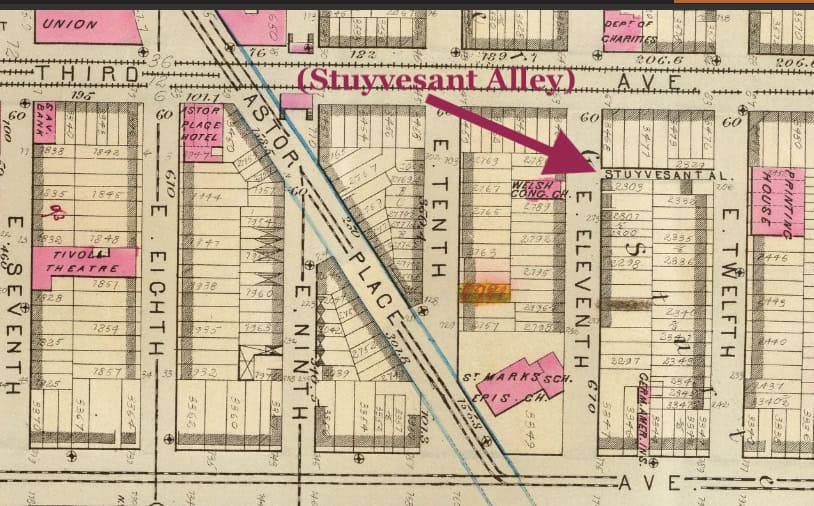
Detail from an 1879 map of New York City — arrow added to point out Stuyvesant Alley.
The excellent Ephemeral New York tracks the alley’s history through to its eventual end. Their account links a nineteenth-century farm parcel to a 1963 downtown map — the kind of small, layered storytelling that makes the city legible across centuries.
Read at Ephemeral New York
“In the narrow places between buildings, the old city still breathes.”
— Luc Sante, Low Life